Before answering this fundamental question, I will take you through the key elements of and issues with a Franchise Agreement. If you are thinking about investing in a franchise, please read through this blog in full as it contains some really important information that you need to be aware about before signing your agreement.

The Franchise Agreement is the foundation of the relationship between the Franchisor and Franchisee and sets the ‘tone’ for how the relationship will work. Clearly not all Franchise Agreements are the same, but the European code of ethics for franchising prescribes essential minimum terms of the agreement which any member of either franchise association in the U.K. would be expected to adopt, and many of them are written by lawyers that are affiliated to one of these two franchise associations.
Misrepresentation
After some Franchisors were found out for making false claims as part of their sales pitch to potential Franchisees, lawyers introduced a clause, known as the ‘entire agreement’ clause (or whole agreement), whereby anything that was said prior to the signing of the Franchise Agreement, including any promises re potential sales and profitability, are in effect ‘null and void’. For this reason, be extremely wary about the sales pitch that the Franchisor uses when trying to court you. They are trying to make the proposition as attractive as possible to you whilst at the same time glossing over all the potential issues I will be highlighting in my blogs.
Side Letter
Most Franchisors will tell you that it is not possible to change the Franchise Agreement as they want it to be consistent across all Franchisees. Whilst this may be true, it is quite common for a ‘side letter‘ to be agreed that is then referred to in the Franchise Agreement. It is imperative that you ask for any promises not covered in the Franchise Agreement or anything in the Franchise Agreement that you are not happy with to be addressed in the ‘side letter’. Bringing anything up after you have signed is too late. I will address this issue in more detail in my blog titled ‘Due Diligence….the most critical step in any franchisee journey’ which you can find here.
Franchisor & Franchisee Obligations
When reviewing a Franchise Agreement you will quickly discover that the list of obligations for a Franchisee are significantly more than for the Franchisor. You will also find that there is a huge amount of focus in any Franchise Agreement on what happens if you fail to fulfil your obligations.
I doubt very much that there is any Franchisee that, at the time of signing their Franchise Agreement, was planning to breach a term in the agreement. However, when you get stuck into the business and you are working 24/7 and constantly fire fighting issues it is very easy to make a mistake that unwittingly breaches a term in the Franchise Agreement.
You will likely find the various terms in your Franchise Agreement classified as ‘substantial’ terms (or something similar) and ‘non’ substantial terms which will have very different implications. For ‘non’ substantial terms, the Franchisee would be given a set amount of time to remedy an issue and if it was not rectified within the timeframe set, the Franchisor could terminate the agreement with immediate effect. However, if any of the ‘substantial terms’ are breached, the Franchisor has the right to terminate the agreement with immediate effect with absolutely no ability for the Franchisee to remedy the breach.
Now just think about this for a minute, you have absolutely no recourse if one of these substantial terms is breached. After reading many different Franchise Agreements it is clear that it is very easy to make an honest mistake which could result in the breach of a substantial term. This could be as simple as forgetting to register a small additional sale when carrying out a service at a customers premises, such as repairing a leaking radiator.
Whilst you may say it is unlikely that the Franchisor will enforce this, the contract you have signed gives the Franchisor this power and therefore it is a massive risk that you really need to consider as the £’000’s you had invested in the business could literally go up in smoke in front of your eyes after breaching any substantial term like this.
In the research I have done about franchising more generally I have heard many stories from Franchisees across multiple Franchisors where issues like this are only brought up at an ‘opportune’ time such as when the Franchisee wants to renew their franchise or when they want to sell their franchise. Some of the stories I have heard have mentioned that Franchisors use this as a negotiation tactic to get something out of the Franchisee such as reducing their geographic area so that they can onboard an additional Franchisee with all the income they would generate in the newly created geography. After hearing the many stories, the cynic in me thinks that Franchisors are happy when Franchisees breach substantial terms as it gives them complete control over the Franchisee for the remainder of the agreement. I cover this issue in my blog on ‘Should I care how my Franchisor makes its money?‘ (Link here).
I highlight these implications because the consequences for the Franchisee of breaching these terms, especially substantial terms, could be catastrophic for the Franchisee and their family. However, you will likely find that there are absolutely no implications detailed in your Franchise Agreement if the Franchisor were to breach any of its obligations and therefore the only recourse open to the Franchisee is to start litigation which is incredibly time consuming, costly and stressful. See my later blog on ‘Litigation’. In my view, there should be a very limited set of substantial terms that are very serious in nature and the bar for breaching a substantial term where there is no opportunity to remedy an issue should be set sufficiently high so that honest mistakes are not penalised in this way. Franchise Agreements should also have reciprocity where there are the same consequences for both parties if either party breach their obligations.
Purchasing restrictions
Every Franchise Agreement will have a clause contracting the Franchisee to buy certain core products and services from the Franchisor but I have yet to come across a Franchise Agreement that includes the price, or even an agreed formula linked to some external reference price, that you will pay for the product. Let me just repeat this, as a Franchisee you are contracted to buy the vast majority, if not all of the products and services you sell or consume, from the Franchisor but the Franchisor has complete control over how much you pay. This means that you have no control over your cost of sales and therefore your profitability. I address this issue in my blog re ‘Should I care how my Franchisor makes its money?‘ (Link here) where I explain why Franchisees need additional protection in this area.
Sales commitments

Another incredibly important section in the Franchise Agreement is the commitment you are agreeing to regarding sales revenue and what the implications are if the targets are not met. The Franchise Agreement will likely include penalties when targets are not met including having to make up the Franchisors lost commissions, having your geographic area reduced in size and worst case terminating the Franchise Agreement. You really need to be confident that you can overcome the many challenges that you will inevitably face with the new business. It may be a new industry for you, it may be the first time running your own business, it may be your first time in a sales role….etc. Some of the larger franchises like McDonalds put you through a comprehensive training program before allowing you to make the final commitment on the franchise (for both the Franchisor and Franchisee) but you do not have this luxury with the vast majority of franchises.
Updates to franchise ‘System’
The Franchise Agreement will very likely include a requirement to implement any changes to the Franchisors service offering including branding, new products, equipment upgrades, display changes, system changes etc. but at your expense and the changes will be required to be implemented in a set period of time. There will be no consideration of whether you agree with the changes or whether you have the necessary funds to implement the changes. There may also be situations where you are coming to the end of your franchise agreement term and you are forced to invest significant sums of money with no ability to recover the costs.
Force Majeure
I expect every Franchise Agreement will include a wide ranging force majeure clause, but let’s be clear, this is not for your benefit. I know that force majeure clauses were widely used during the recent pandemic but I have heard stories where Franchisees were not able to leverage the clause to get relief from minimum commission payments even when the business was not able to trade. One of the most famous recent public cases where I believe the Franchisor used their force majeure clause was when KFC could not supply chicken to its stores after a change of logistics provider – see details here. This was a very public issue that received National paper headlines and clearly created a huge amount of friction between the Franchisor and Franchisee.
Franchise Agreement Term
According to Pip Wilkins, CEO of the BFA, ‘Ordinarily a Franchise Agreement will be 5 years with an automatic right to renew at the end of the agreement, if you have been a good franchisee’. There are many franchise agreements that are 10 and some even 15 – 20 years. It is said that the term of an agreement should be long enough to recover your initial investment which means that the higher your initial investment the longer the term. I believe that as a general rule of thumb, you should only be investing in a franchise that is longer than 5 years if the Franchise has a long established record of providing franchisees with a great return on their investment (not turnover!). I also strongly believe that any franchise agreement with a term longer than 5 years should have a break clause, similar to a lease, that gives the franchisee the ability to terminate the agreement at specific milestones throughout the term (e.g. every 3 or 5 years). The franchisee should then align other major commitments with these milestones so that you are not stuck with contractual commitments beyond the term of the franchise agreement.
Signing a Franchise Agreement
Franchise Agreements are written by the Franchisor and their lawyers for the sole benefit of the Franchisor so DO NOT believe anyone, especially a Franchisor or their lawyers, if they claim otherwise.
The two UK franchise associations, the BFA and the QFA, also have an affiliate and supplier member scheme where suppliers to the Franchise Industry, like lawyers, pay money to become ‘members’ and these suppliers can then use this accreditation to sell their services to both Franchisors and Franchisees. In a later blog on ‘Franchising governance – is it time for regulation of the franchise industry in the U.K.?’ I will review the effectiveness or otherwise of the current governance of the franchise industry in the U.K..
Although I believe it is not possible for a franchise lawyer to provide advice to both a Franchisor and one of their Franchisees at the same time, I believe they are still conflicted because if a Franchise Agreement passes the franchise association’s own ethical test, how can they argue against it for a Franchisee and at same time support it for another Franchisor. I would guess that any franchise association would be ‘none too pleased’ with this scenario as it would be an attack on one of their own ‘family’!
You will struggle to find a commercial lawyer, not connected to the Franchise industry, that will advise their client to sign such a one sided agreement. In my view, this just proves the fact that lawyers closely connected to the franchise industry are conflicted. I also believe that many potential Franchisees know this and decide against spending money on legal advice in the knowledge they will be advised against signing the agreement. They, like me, were of the mistaken belief that if there are already lots of Franchisees with the same agreement and there is no negative publicity about the Franchisor in the public domain, then everything must be ok. Prior to signing my franchise agreement, I reached out to a friend, who also happens to be a McDonalds franchisee, for advice and he said ’Indeed… It’s a cost of doing a franchise! Any solicitor will tell you not to sign it but then you still do’. This may be fine with a Franchisor like McDonalds that has strong values, not just on paper, but sadly not everyone has the same values as McDonalds and others are ‘Unscrupulous and dishonest’ and will not act in ‘good faith’.
Whilst it may be true that not many Franchisees actually end up in court with their Franchisor, this is only because the vast majority (generally estimated to be >95%) of legal battles end up being settled prior to court. I would bet that in the vast majority of these cases it is the Franchisee that settles because of the financial muscle of the Franchisor and the financial and mental stress that legal battles like this cause for individual Franchisees.

Signing a Franchise Agreement is not like signing a contract of employment which you can leave at any time. By signing a Franchise Agreement, your are committing to everything in the agreement for the full period of the contract, which may be 5, 10 or even 15 years.
Franchisors go out of their way to ‘court’ Franchisees that are asset rich because they know they have deeper pockets to withstand any issues such as a cash flow problem but the Franchisor also knows they have assets that they can go after if the Franchisee decides they want out. This also explains why Franchisors like people that have recently received a redundancy payment. The BFA even has a guide to franchising targeted at people that have been made redundant.
Before signing a Franchise Agreement you must familiarise yourself with the potential implications if things turn sour and you must be fully prepared to accept the real worst case scenario, because believe me things do go wrong and a lot more frequently than you might think.
Without you even knowing it, Franchisors will try and persuade you and your spouse/partner to sign the Franchise Agreement, as individuals, as you will then both be liable if things turn sour. Please, please, please avoid this at all costs as all of your assets are then at risk. Ironically a few of the larger more successful franchises will only allow one signature per family.
Personal Guarantee
By signing a Franchise Agreement as an individual, principal or guarantor as opposed to only signing the agreement as a director of the company that is being contracted to operate the franchise, you are giving a personal guarantee for any potential debts that result from the business. This means that you are personally liable if something goes wrong and any debts need repaying that the company cannot fund.
Franchisors make a lot of the fact that their track record as a Franchisor can open doors with banks that will be happy to provide a loan to your business to help with start-up costs and working capital. The Franchisors will likely help prepare your business case for you as this will likely improve the chances of getting the loan! However, as a new business, it is highly likely that you will have to provide a personal guarantee for the bank loan. I know of only one Franchise, McDonalds (but there may be more) where the Franchisor and the banks they work with do not expect individuals to provide a personal guarantee but this is probably because even if a Franchisee were to fail, McDonalds would very likely bail or buy them out.
What happens if it doesn’t work out as expected?
So what happens if you don’t like it, or it doesn’t suit you, or selling isn’t your thing or the promised money tree is not there or you don’t like the Franchisors culture or the Franchisor decides they don’t like you….? You are basically stuck for the length of the agreement (5…10…15 years…) unless of course you decide to negotiate your way out. Please do not fall into the trap of thinking that it won’t happen to you (like I did!) because it happens to a lot of Franchisees, a fact that will not be visible to you because of the use of NDAs to gag Franchisees. See my future blogs on ‘dealing with disputes’, ‘exiting a franchise early’ and ‘the use of NDAs to protect the perimeter of a franchise’ (Link here).

If something does go wrong, the Franchise Agreement may include clauses that specify the process you need to follow to raise a dispute and a requirement to go through mediation or arbitration with a mediator appointed by the relevant franchise association, before you can start litigation. It may also include clauses that prevent you from talking publicly or maybe even talking with other franchisees about your grievance or dispute which is very likely to be a substantial term, and therefore if breached, the Franchisor could terminate the agreement with immediate effect. See my blog on ‘the importance of Culture and Values in any franchise’ (Link here) and my upcoming blog on ‘Collaboration‘ with other franchisees
Every Franchise Agreement will include a section about what happens if you choose to terminate your Franchise Agreement prior to the end of the agreed term. Please bear in mind how much power the Franchisor has over its Franchisee and how easy it is for the Franchisor to terminate the agreement with immediate effect. The Franchise Agreement will lay out the so called ‘liquidated damages’ you will have to pay to the Franchisor, which will be dependent on how much time is remaining in the agreement. In plain English this could require you to pay to the Franchisor the commissions and other revenues (e.g. advertising) that they would have earned from you if you had stayed until the end of the agreement along with the Franchisors costs. So assuming you are not able to sell your business, as if losing your business and all your investment in it was not bad enough, you will then be liable for the liquidated damages, the amount of which will depend on the length of term remaining in your Franchise Agreement, but which can run into hundreds of thousands of pounds and in some cases over a million. These staggering costs must be paid even if the Franchisor has lined up another Franchisee to replace you the day after the agreement is terminated.
This is akin to a Franchisee falling to the floor after numerous heavy blows and then being kicked repeatedly in the head until unconscious (apologies for being so vivid but this is exactly what it feels like).
I really wish a Franchisee would take on their Franchisor to test whether these completely draconian liquidated damages would stand up in a court of law because they are clearly completely immoral and should be outlawed. I knew what the worst case scenario was in my situation but like so many others believed that this could never happen to me. See my blog titled ‘Should I care how my Franchisor makes it’s money?‘ (Link here) where I share further views on liquidated damages and a blog titled ‘exiting a franchise early’ where I will share details of my own experience and also those of other Franchisees that have been able to share their story.
Selling your franchise
All Franchise Agreements will include a clause detailing the process that must be followed when you want to sell your business. I will cover this topic in more detail in a later blog called ‘Valuing & selling a franchise business’ but for now the thing you need to be very wary about is how much of a role the Franchisor will play in the sale process and what their commissions etc. are. Just like you had to be screened by the Franchisor before they accepted you as a Franchisee, they will have to do the same with any prospective purchaser of the franchise which means that the Franchisor once again has complete control over the process and the outcome.
I have seen clauses in a number of Franchise Agreements that allow the Franchisor to intervene in the sale process if they believe the price being charged is not a ‘fair value’ for the business. The Franchisor reserves the right to appoint an independent Valuer and whatever price the Valuer comes up with for the business is ‘conclusive and binding’! Unbelievably the Franchisor then has the right to buy the business at the Valuer’s price if the Valuer’s price is less than the price that the Franchisee had agreed with their new purchaser.
Use of Non Disclosure Agreements (NDAs)

Franchisors use NDAs to protect their business at every stage of the journey. Many Franchise Agreements include clauses that even prevent you from disclosing the content of the Franchise Agreement with any 3rd party other than with ‘professional’ advisors.
Most Franchise Agreements will also include a clause preventing the Franchisee from airing any grievance or complaint in public which is another reason why you rarely hear of any disputes between Franchisees and their Franchisors.
See my blog on ‘Why are Franchisors and their lawyers so desperate to gag their Franchisees?’ (Link here) where I highlight the extent Franchisors are willing to go to prevent any negative information from being shared publicly and my views on the very limited number of cases that they should be used.
It is for these reasons that I believe that Franchise Agreements are probably the most one sided commercial agreement with all the power with one party and all the potential downsides with the other party.
I have tried to focus on the key sections of the Franchise Agreement where I believe there is most risk but please take the time to get to know your own Franchise Agreement before signing it and avoid reading it with rose tinted glasses thinking issues like the above will never happen to you, because believe me…..it can and likely will.
In my next blog on the topic of ‘Due Diligence….Ignore it at your Peril‘ (link here), I will explain what I believe you need to do to minimise some of the risks highlighted in this blog.
So let’s just go through this…
- The agreement is completely one sided
- You personally take on all of the risk and your agreement can be terminated with immediate effect, even for something that was a simple honest mistake
- You are contracted to buy your products and maybe even some services from the Franchisor but they control how much you are going to pay for them
- If a Franchisor decides to make a change to their ‘system’ you will be obligated to introduce this change, within an agreed timeline, at your expense and likely with suppliers that have been contracted by the Franchisor
- You have no control over who owns the business, who your ‘boss’ is, what their strategy is, what culture and values they want…..and you can’t leave…..like you can if you were an employee
- If you become ill or it doesn’t work out, and assuming you can’t sell the franchise, you’ll have to pay a small fortune to exit the franchise early in addition to losing everything you had already invested in the business
- If something does go wrong, you won’t be able to air your grievance or complaint publicly as your agreement is very likely to be terminated
- If you want to sell the franchise, the Franchisor has complete control over the process and outcome and could even step in and buy the business from you for less than the price you agreed with your purchaser!
- When you do eventually leave, it is highly likely that you will be prevented from sharing your story, even with your own mother!
Marriage Analogy
Signing a Franchise Agreement (FA) is akin to getting married on your first date and signing a prenuptial agreement that gives complete control of your affairs to your new spouse. In fact, it is even worse than this because with a Franchise Agreement your ‘spouse’ also has the ability to leave the ‘relationship’ and replace themselves with someone of their own choosing! And that’s not all…..with a Franchise Agreement, your ‘spouse’ can always choose a different direction for the relationship which you may not agree with and can’t get out of. There’s not many people in the world that would entertain such an arrangement so why would you risk your financial and mental health by signing a Franchise Agreement?
In some ways the issue, as I see it, with Franchise Agreements reminds me of the feudal system with property leases in the UK, where freeholders are taking advantage of leaseholders, but thankfully the government are part of the way through addressing the issue.
So…..are Franchise Agreements ‘ethical’?
An experienced Franchisor and franchise consultant, recently said ‘franchising should be an honest, collaborative, mutually beneficial relationship on all levels’, which I couldn’t agree more with and the Franchise Agreement should be the foundation of this.
One of the best known Franchisors, sadly for all the wrong reasons, is actually The Post Office. The post office prosecuted over 736 SubPostMasters (SPMs) using data from the (now known to be) flawed Horizon IT system. Sadly many of these people ended up in jail, and even more sadly, some of these people ended up taking their own lives. The legal cases to overturn the hundreds of wrongful convictions of SPMs is ongoing but in the case of Alan Bates and others Vs Post Office Ltd, the judge found that many of the terms in the Franchise Agreement were ‘onerous’ and failed the test of ‘reasonableness’ which meant they could not be relied upon. Based on this judgement, I think it is safe to conclude that the Post Office Franchise Agreement was unethical both in terms of its content but also how it was enforced. I will come back to the really critical principle of acting in ‘good faith’ in my blog on ‘the importance of culture and values within a franchise’ (Link here).
Sadly, consequences like those experienced by the SPMs are very real and anyone thinking of signing a Franchise Agreement needs to be fully aware of the risks involved before signing the dotted line.
According to the BFA, ‘our core aim is to support and influence high quality ethical business format franchising in accordance with the European Code of Ethics’. Similarly the QFA has their own code of conduct which looks similar to the European Code of Ethics. It should then follow that the Franchise Agreement of any member of the BFA or the QFA should be an ‘ethical’ agreement.
In my view not only are Franchise Agreements completely one sided but based on my analysis above, there is absolutely nothing ethical about a Franchise Agreement with terms like this.
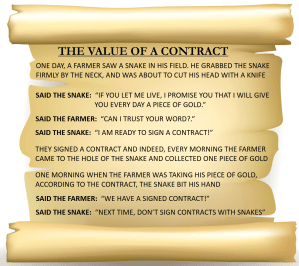
By signing a Franchise Agreement that contains these types of terms, rather than being protected by the terms of the agreement, you are actually putting your complete trust and faith in the goodwill of the Franchisor, someone that you don’t know and who could change at any time, which is a massive risk. After reviewing a number of real life case studies Sir Geoffrey Cox KC, the MP and Attorney General, referred to Franchisors that take advantage of agreements like this as ‘unscrupulous and dishonest franchises’.
If you still decide to go ahead and sign your Franchise Agreement, at least you are doing so with better knowledge of the risks involved.
So what would I do knowing what I know now?
If I knew what I know now and after experiencing, seeing and hearing about the mental and financial suffering that so many Franchisees go through (I am now being contacted regularly by people that have been through a horror story of some sort), I would not sign an agreement like this with any Franchisor, no matter what their size or profile, because the risks involved are way too high and the potential consequences catastrophic.
In my final blog, I will try and summarise the changes I believe are required to the franchise industry, including the agreement, before I believe it can be considered ethical.
My request to you…
My request to you is to share your own personal experiences with your Franchise Agreement in the comments box below.
- Do you have similar clauses in your agreement and do you now recognise these issues?
- Are there any other clauses that prospective Franchisees should be aware of?
- Have you ever encountered a contractual issue with your Franchisor and if so how did the Franchisor handle it?
- Do you have any other experiences that current or prospective Franchisees would benefit hearing about?
If you are worried about posting your experiences publicly, please share them with me directly through the contact form or via the email link and I can then share them anonymously.
Please share this blog with other Franchisees as well as anyone you know that may be thinking of investing in a franchise and ask them to subscribe here for future blogs.
It is worth re-iterating the point that there are many good Franchisors that act in good faith but the focus of this blog is on ‘The Perils of Franchising’ as there is little or no public information available about the real risks involved in investing in a franchise.
Details about the author and his experience of being a Franchisee can be found here. Just to be clear, the authors’ views expressed in this blog are exactly that….his views, based on his personal experiences, by connecting with many current and past franchisees of many different Franchisors and through his own market research.
#theperilsoffranchising, #franchise, #franchisor, #franchisee, #franchising, #franchiseagreement, #McDonalds, #KFC, #BFA, #britishfranchiseassociation, #qfa, #qualityfranchiseassociation, #postoffice, #postofficeltd, #pol, #horizon, #horizonscandal, #postofficescandal, #sirgeoffreycox
 The Perils of Franchising
Having been a franchisee for over 30 years I can honestly say I have seen more franchisees go bust than the few who have done well. NDA are rife so the public never hear. The franchise industry regularly state figures that franchising is safer than going it alone. I have been searching for the source of those figures but have never found it. BE CAREFULL IT IS NOT AS GOOD AS THE SALESMAN SAY.
LikeLike