
After reading this blog you will understand the extent many Franchisors are willing to go to gag their Franchisees and why I believe they are so desperate to do so.
At every step of the Franchisee’s journey the Franchisor will gag the Franchisee to prevent any information about the franchise from being shared publicly. Franchisors go to huge effort to protect the perimeter of their business rather than focusing this effort on ensuring that their franchise business is a real success for everyone involved, including their franchisees.
After reviewing the Franchise Agreements of many different franchises, the following non disclosure clauses are the most common ones other than numbers 10 and 11 in the diagram below which are examples from my case;

Before Franchise
1. NDA re Franchise Agreement (FA) – Many Franchisors now include the Franchise Agreement itself as part of their definition of confidential materials that cannot be shared with any third party other than professional advisers. In my view, there is nothing (or at least does not have to be anything) confidential in the draft template of a franchise agreement. All regulated countries insist that franchise agreements are disclosed and available for anyone to see, so why not in the UK? What is it that Franchisors in the U.K. are trying to hide?
2. NDA re financials of existing franchisees – I have yet to hear of any franchise in the UK that will make samples of the redacted financials of their existing franchisees available before signing a confidentiality agreement. As with the Franchise Agreement, all regulated countries insist that redacted financials are disclosed and available for anyone to see, so why not in the UK?
3. NDA re Franchise ‘System’ – The ‘System’ is normally documented in the Operating Manual of the Franchise and includes all of the operational procedures for the business and is therefore it’s ‘secret sauce’. I have no issue keeping this confidential but Franchisees should be given ample time to review this before signing the Franchise Agreement because it may have requirements that the potential Franchisee is uncomfortable signing up to. I believe that if the Operating Manual is unseen prior to signing the Franchise Agreement, by law the Franchisee will have a limited period of time post signing to cancel it but by this stage the Franchisee will already have paid their franchise fee. It is worth noting that the Franchise Agreement invariably gives the Franchisor the right to change the Operating Manual at any time including things like rebranding, modifications to payment systems, new feed and product offerings – all of which mean large additional costs to Franchisees.
During Franchise
4. Ban on Collective bargaining – Some Franchise Agreements ban franchisees from working together with other franchisees to challenge their Franchisor on any issue or to join any association that may promote change within the industry.
“Not to participate in or register with any Internet group, website or similar medium or with any organisation advocating change to the franchise industry”
5 & 6. Ban on speaking negatively in public – this seeks to prevent the franchisee from discussing with or disclosing anything about any dispute between the Franchisor and any of its franchisees or sharing anything negative or disparaging about the franchise with any 3rd party, including the press.
“The Franchisee and the Principal will not reveal to or discuss with any third party any details of any dispute or disagreement between the Franchisor, the Principal and the Franchisee or between the Franchisor and any other third party.”
After Franchise
7. Post termination clause in FA banning speaking negatively in public – Same as 5 & 6 but applies in perpetuity even after you have left the franchise.
“Not at any time post termination of this agreement make any disparaging or negative comments about the Franchisor or do anything to damage the Franchisor’s goodwill or reputation”
8. Wide ranging NDA as part of any settlement agreement – Franchisors include draconian liquidated damage clauses in their agreements in the case of franchisee failure or the termination of the agreement. One of the reasons why they include this is to give them leverage in exit negotiatios where the Franchisor may give a reduction on the damages in return for signing an NDA that would mean that you would not even be able to tell your mother that you had worked with the franchise.
Since starting my blog series, I have connected with many ex franchisees that have settled their cases and they are terrified of saying anything in public because they know that a threatening letter from their ex Franchisors’ solicitors will arrive in their inbox or by post the next day.
9. NDA re complaint to any Franchise Association as part of any settlement – as with 8. above, Franchisors use their leverage to include a clause in the settlement preventing the Franchisee from making any complaint to their Franchise Association about the Franchisor. This has the effect of burying potentially serious issues about the Franchisor but the British Franchise Association clearly doesn’t see it as an issue as they appear to do nothing to stop this.
10. NDA preventing complaint to Solicitors Regulation Authority (SRA) – In my litigation battle with the franchise Dream Doors, I had an extremely concerning event whilst in negotiations to settle my case, where I was pressurised into signing an NDA where I would “irrevocably withdraw all complaints about and to….Owen White Limited [now IBB Law] to the SRA or any other body.”
It is not clear to me who drove the decision to make this demand but the normal process is for solicitors to take instructions from their clients. Assuming it was Dream Doors that drove this requirement, why did a supposedly well respected law firm that claims to advise “around 100 Franchisors in the UK” and “We set ourselves high standards. Our reputation is important to us” agree to it knowing that it would risk their reputation and license to operate? Were they expecting my solicitors to ignore it and just get me to sign the NDA? Is this something that happens frequently in the franchise industry? I don’t know the answer to these questions but I do have my suspicions why my Franchisor was so keen to silence me. I will explain one of these suspicions in an upcoming blog which I am calling ‘The Great Franchise Fraud’.
One of the solicitors involved, Russell Ford, was sanctioned (Link here) by the SRA for his involvement in this issue.
In any case, I am confident that a term in an NDA that seeks to gag reporting to any regulatory body is against the public interest and therefore highly likely to be unenforceable.
11. Defamation threats – Since settling my case I have had two separate threats of defamation from my ex Franchisor, the most recent of which related to the ‘My Story‘ page on my blog where they claimed that because I had chosen to settle my case that I “cannot have a reasonable belief in the contents of the Website”. They went on to demand that I;
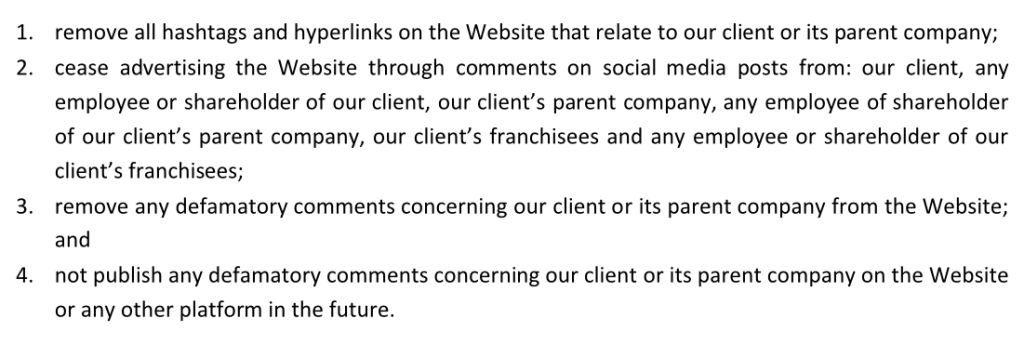
I pushed back very strongly on both of these claims because the content of my blogs is true and/or my honest opinion and in any case they cannot make demands like no. 1 or 2. No further action has been taken.
I believe that threats of defamation like this are a further tactic used by Companies, including Franchisors to silence their critics. Interestingly, the SRA have issued a warning notice to solicitors regarding so called SLAPPs (Strategic lawsuit against public participation) because they believe that they “have the potential to be a threat to the rule of law and free speech”.
Inappropriate use of Without Prejudice and Private and Confidential labels
Another issue referenced in the same warning notice from the SRA to solicitors is the misuse of labels like “Private and Confidential” and “Without Prejudice”. I have encountered this issue myself on a number of occasions, most recently with the latest threat of defamation that I referenced above where the letter was incorrectly labelled “Private and Confidential” which the solicitor, when challenged, explained was just a mistake on their part. It has also recently come up as an issue in the Post Office Scandal linked to compensation payments (Tax Policy Associates Blog on use of WP labels). The SRA clearly believes that this is a further tactic used by solicitors to intimidate defendants, especially those unrepresented (LIPs).
Consequences of breaching NDAs
The consequences of breaching any NDA clause is dependent on the terms within the Franchise Agreement but in every case I have reviewed, it would have resulted in the immediate termination of the Franchise Agreement which would then have triggered liquidated damages that could run into the £millions depending on the terms of the agreement and the length remaining on the contract.
Ethical or not?
Are these the behaviours and actions of a Franchise Industry that wants an open and collaborative environment where risks and rewards are shared or one that is more intent on hiding their actions and behaviours and the real life experiences of their Franchisees inside the perimeter of a franchise enabled by gagging clauses? Is this really an ethical way of doing business?
In my view, the actions of both my Franchisor, Dream Doors (part of the Neighbourly group of franchises), and their solicitors, Owen White (now part of IBB Law), both of whom are members of the BFA, were unethical.
I have separately reviewed the Franchise Agreements from multiple Franchisors, many of whom are members of the BFA, and gagging clauses like the ones I have mentioned in this blog are included in them. This indicates to me that the BFA supports the silencing of Franchisees and accepts that potential Franchisees do not have access to the real life experiences of Franchisees. It also means that the BFA do not have access to the real information about what is going on within their members’ Franchisees and as such I don’t see how it is possible for them to claim that they are “setting the highest ethical standards to make sure everyone is treated fairly”.
So why are Franchisors desperate to gag their Franchisees?
Clearly the reason why Franchisors use NDAs at every step of a Franchisees journey is to have complete control over their narrative in public but, in my opinion, to do so at the expense of issues of real public interest is completely wrong. Using NDAs to protect truly confidential business information and trade secrets or to protect the terms of a settlement agreement are absolutely fine in my view but to use them to ‘bury’ information about important issues like;
- A poorly performing franchise
- A toxic culture
- Sexual harassment, racism, bullying, and discrimination
- Underhand sales tactics
- Fraudulent or dishonest behaviours
- Evidence
- etc.
is completely wrong and deprives potential Franchisees of the data they need to make an informed decision about whether or not to invest their life savings in a franchise.
I don’t believe that anyone would want to bad mouth any business, let alone a Franchisor, that behaved ethically and acted in good faith. As such, in my view it would make far more sense for Franchisors to focus their efforts on ensuring that the franchise is a success for everyone involved, including their Franchisees.
Just like staff of a company can share their views about their experience as an employee or customers of a restaurant can share their views about a dining experience, Franchisees should have the legal right to share their experiences about being a Franchisee.
In any case, libel laws exist to protect companies and individuals from any false accusations that cause material damage to their business.

With the current direction of travel, we are in real danger of getting to a position where there is a complete information vacuum because on the one hand there is no regulation of the industry mandating Franchisors to disclose certain key pieces of information and on the other hand Franchisors have complete control of their narrative turning the perimeter around the franchise into something akin to Fort Knox.
Broader issue re use of NDAs
The sad reality is that NDAs are now used and abused in every walk of life. Examples include the House building industry, F1, the Post Office scandal and general discrimination in the workplace. Unfortunately as with so much in society nowadays, money talks and those with it will quickly resort to the use of NDAs to silence their critics. This is summed up perfectly by the lawyer, Bradley Edwards, who represented many of the victims of Jeffrey Epstein when he characterised the use of NDAs as “the work of the powerful to control the vulnerable” and by a quote I recently saw on LinkedIn “The root cause of almost all scandals is the unchecked power of Corporations and wealthy elites to bludgeon people into silence and submission”.
Organisations like the not for profit Can’t Buy My Silence have been established to advocate for the introduction of legislation to make NDAs unenforceable for anything other than their original purpose – to prevent the sharing of confidential business information and trade secrets.
The regulation of NDAs was recently raised in the House of Commons where an MP highlighted that they are “covering up mismanagement, misconduct and even crimes at work” and asked the PM to consider “banning their use in all severance agreements once and for all”.
Urgent need for regulation of the Franchise Industry
Whilst NDAs and gagging clauses continue to be legal and used extensively in the Franchise Industry in order to silence Franchisees and protect the perimeter of a franchise, it is criticality important to introduce regulation of the industry as happens in the vast majority of other developed countries. This regulation would ensure that certain key bits of information that is currently not provided at all or provided under NDA, especially in the case of franchisee financial performance, franchisee turnover, litigation history and reasons for the same, would have to be made transparent for anyone to see. Franchisees would then have access to the information they need to make an informed decision about whether to invest or not in a franchise and more importantly would have recourse in the courts if inaccurate information is supplied to the Franchisee. I will be covering this topic in a future blog on the governance of the franchise industry in the U.K.
It is worth highlighting that Franchisees should seek legal advice before signing an NDA. If a Franchisee has already signed an NDA they can still seek legal advice, because it may be that [parts of] the NDA is [are] not worth the paper they are written on.
The absence of any regulation of the franchise industry in the U.K. means that the Due Diligence phase is ‘the most critical phase of any Franchisee’s journey’ and just happens to be the subject of my next blog!
Make some noise….
On a personal note, I never had any urge to talk negatively about any of my employers throughout my 30+ corporate career, despite many challenging situations, but because of my personal experience as a Franchisee and hearing so many harrowing stories from other Franchisees where their livelihoods have been ruined at the hands of ‘Unscrupulous and dishonest franchises’ I couldn’t sit back and do nothing.
Nick Gould, one of the incredible lawyers that supported the Sub Postmasters pro bono in some of the critical early successes against the Post Office and continues to support them today shared the following quote from John Lewis with me, which I use to keep myself motivated to fight the case for regulation of the Franchise industry.
“Do not get lost in a sea of despair. Be hopeful, be optimistic. Our struggle is not the struggle of a day, a week, a month or a year, it is the struggle of a lifetime. Never, ever be afraid to make some noise and get in good trouble, necessary trouble.”
——————
My request to you…
I would love to hear back from Franchisors, Franchisees and legal professionals (in fact anyone!) about your own experiences with NDAs or gagging clauses.
- Do you think they are a necessary part of doing business?
- Should their use be restricted?
- Do you have any personal stories re the misuse of NDAs that you would be willing to share?
- Do you support the introduction of regulation in the franchise industry in the U.K. as exists in most other developed countries?
If you are worried about posting your experiences publicly, please share them with me directly through the contact form and I can then share them anonymously.
Please share this blog with other Franchisees as well as anyone you know that may be thinking of investing in a franchise and ask them to subscribe here for future blogs.
It is worth re-iterating the point that there are many good Franchisors that act in good faith but the focus of this blog is on ‘The Perils of Franchising’ as there is little or no public information available about the real risks involved in investing in a franchise.
Details about the author and his experience of being a Franchisee can be found here. Just to be clear, the authors’ views expressed in this blog are exactly that….his views, based on his personal experiences, by connecting with many current and past franchisees of many different Franchisors and through his own market research.
#theperilsoffranchising #franchise #franchisor #franchisee #franchising #thepostoffice #SRA #dreamdoors #neighbourly #neighborly #ibblaw #franchiseregulation
Copyright © The Perils of Franchising. All rights reserved.
 The Perils of Franchising
6 comments